


ClickUp connector
OAuth 2.0 project_managementConnect to ClickUp. Manage tasks, projects, workspaces, and team collaboration
ClickUp connector
-
Install the SDK
Section titled “Install the SDK”Terminal window npm install @scalekit-sdk/nodeTerminal window pip install scalekit -
Set your credentials
Section titled “Set your credentials”Add your Scalekit credentials to your
.envfile. Find values in app.scalekit.com > Developers > API Credentials..env SCALEKIT_ENVIRONMENT_URL=<your-environment-url>SCALEKIT_CLIENT_ID=<your-client-id>SCALEKIT_CLIENT_SECRET=<your-client-secret> -
Set up the connector
Section titled “Set up the connector”Register your ClickUp credentials with Scalekit so it handles the token lifecycle. You do this once per environment.
Dashboard setup steps
Register your Scalekit environment with the ClickUp connector so Scalekit handles the authentication flow and token lifecycle for you. The connection name you create will be used to identify and invoke the connection programmatically. Then complete the configuration in your application as follows:
-
Set up auth redirects
-
In Scalekit dashboard, go to AgentKit > Connections > Create Connection. Find ClickUp and click Create. Copy the redirect URI. It looks like
https://<SCALEKIT_ENVIRONMENT_URL>/sso/v1/oauth/<CONNECTION_ID>/callback.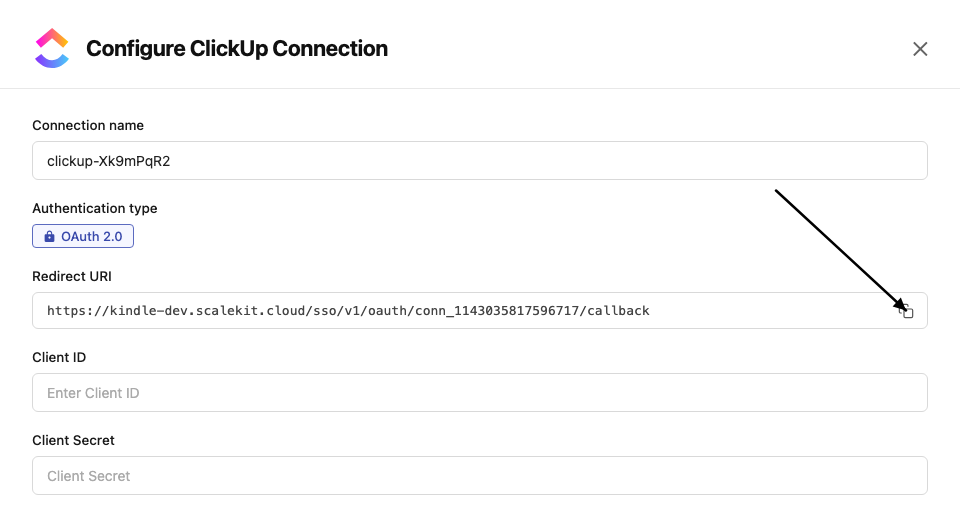
-
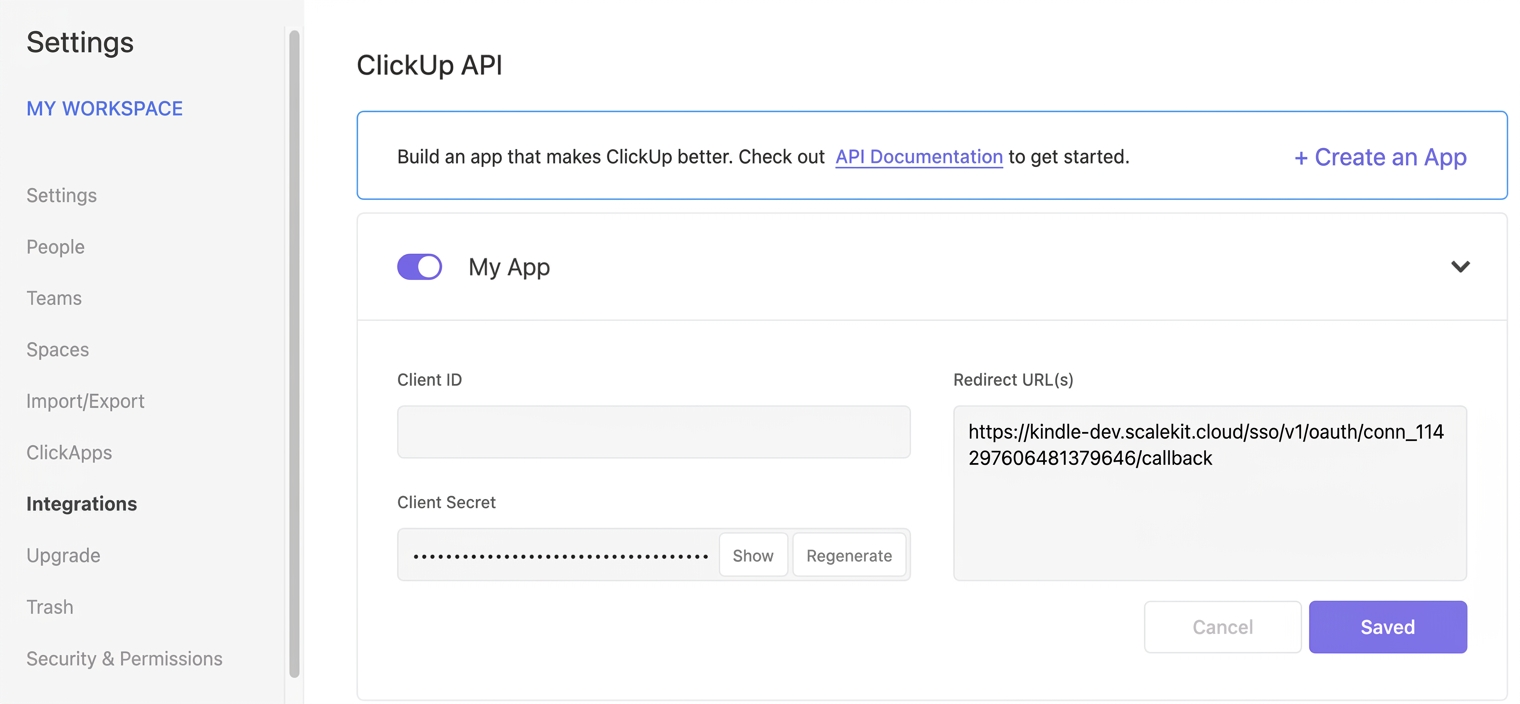
In ClickUp, click your Workspace avatar (lower-left corner) → Settings → Integrations → ClickUp API.
-
Open your application and paste the copied URI under Redirect URL(s), then save.
-
-
Get client credentials
On your ClickUp application page (Settings → Integrations → ClickUp API):
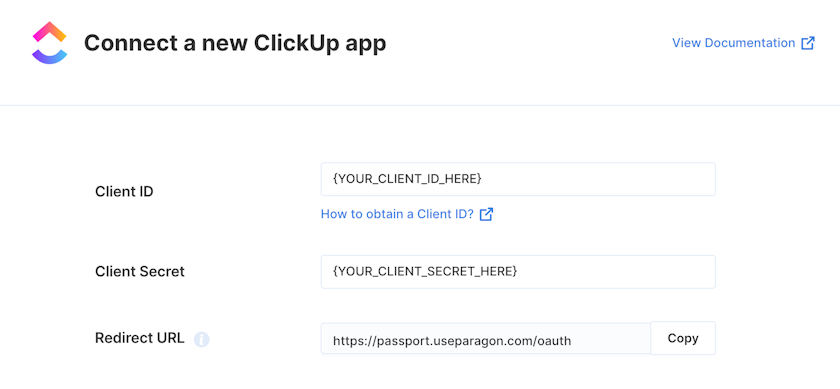
- Client ID — found under Client ID on your app page
- Client Secret — found under Client Secret on your app page
-
Add credentials in Scalekit
-
In Scalekit dashboard, go to AgentKit > Connections and open the connection you created.
-
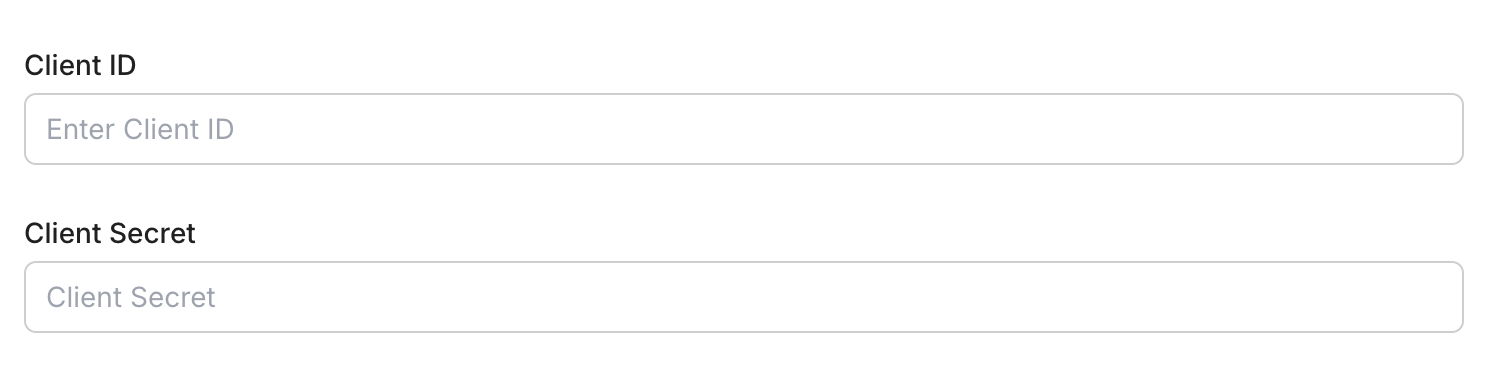
Enter your credentials:
- Client ID (from your ClickUp app page)
- Client Secret (from your ClickUp app page)
-
Click Save.
-
-
-
Authorize and make your first call
Section titled “Authorize and make your first call”quickstart.ts import { ScalekitClient } from '@scalekit-sdk/node'import 'dotenv/config'const scalekit = new ScalekitClient(process.env.SCALEKIT_ENV_URL,process.env.SCALEKIT_CLIENT_ID,process.env.SCALEKIT_CLIENT_SECRET,)const actions = scalekit.actionsconst connector = 'clickup'const identifier = 'user_123'// Generate an authorization link for the userconst { link } = await actions.getAuthorizationLink({ connectionName: connector, identifier })console.log('Authorize ClickUp:', link)process.stdout.write('Press Enter after authorizing...')await new Promise(r => process.stdin.once('data', r))// Make your first API call through the proxyconst result = await actions.request({connectionName: connector,identifier,path: '/api/v2/user',method: 'GET',})console.log(result)quickstart.py import osfrom scalekit.client import ScalekitClientfrom dotenv import load_dotenvload_dotenv()scalekit_client = ScalekitClient(env_url=os.getenv("SCALEKIT_ENV_URL"),client_id=os.getenv("SCALEKIT_CLIENT_ID"),client_secret=os.getenv("SCALEKIT_CLIENT_SECRET"),)actions = scalekit_client.actionsconnection_name = "clickup"identifier = "user_123"# Generate an authorization link for the userlink_response = actions.get_authorization_link(connection_name=connection_name,identifier=identifier,)print("Authorize ClickUp:", link_response.link)input("Press Enter after authorizing...")# Make your first API call through the proxyresult = actions.request(connection_name=connection_name,identifier=identifier,path="/api/v2/user",method="GET",)print(result)
Common workflows
Section titled “Common workflows”Proxy API call
const result = await actions.request({ connectionName: 'clickup', identifier: 'user_123', path: '/api/v2/user', method: 'GET',});console.log(result);result = actions.request( connection_name='clickup', identifier='user_123', path="/api/v2/user", method="GET")print(result)Execute a tool
const result = await actions.executeTool({ connector: 'clickup', identifier: 'user_123', toolName: 'clickup_list', toolInput: {},});console.log(result);result = actions.execute_tool( tool_input={}, tool_name='clickup_list', connection_name='clickup', identifier='user_123',)print(result)